
- About the MBTI
- Verify Your MBTI Type
- Personality Patterns
- MBTI Articles & Resources
- Article Directory for Educators & Students
- Books on Personality Types
- Emotional Intelligence & Personality Type
- Career Planning & MBTI
- MBTI Business Applications
- Lenore Thomson - Carl Jung Personality Type
- Site Map - Master Directory of All Articles
- MBTI Consultant Links
- Personality Type Workshops & Conferences
- Links to Other Type Websites
- Murder Mystery Business Theatre
- About Us
Understanding the MBTI ® and Personality Type
An exploration of Emotions, Feeling & Emotional Intelligence
By Ross Reinhold, INTJ
Article Index
Page 1. Emotional Intelligence
Page 2. EI, EQ & MBTI Type
Page 3. Emotion & Feeling
Page 4. Feeling + Thinking
Book Review: "The Parasitic Mind: How Infectious Ideas are Killing Common Sense" - The Civil War between Feeling and Thinking?
What is EQ and EI
“What’s your child’s EQ?” may soon rival the importance of IQ to parents and educators. EQ stands for Emotional Quotient and is the measurement equivalent of what is called “emotional intelligence” . . . or EI for short.
Reflecting this rising interest in the subject, an issue of the Bulletin for Psychological Type (Vol. 29, No.3 2006) had a series of articles on Emotional Intelligence and its relationship to personality type. One of the reasons people in the type community are interested in EQ is that the language of EQ frequently makes reference to feelings and identifies desirable EQ traits, like empathy, that are frequently correlated with the Jungian mental function of Feeling. On the surface it seems like there should be some compatibility between the models and in particular with Feeling judgment. But when I delved into this subject more deeply, I came away with a different conclusion. This nosing around Emotional Intelligence prompted me to pick up a related topic that has piqued my curiosity: the relationship of emotion to Jung-Myers mental function of Feeling.
What is Emotional Intelligence (EI)?
Many, including the contributors to Wikipedia, believe EI is rooted in a theory of “Multiple Intelligences” originally developed by psychologist Howard Gardner. Gardner believed the traditional IQ test and related measures of learning ability failed to capture the full range of human intelligence. His interest in this subject lead to his developing a "Theory of Multiple Intelligences" (1983) in which he identified what he believed were seven primary intelligences. Some intelligences were similar to the conventional concept of "intelligence" but others touched upon talents not commonly associated with IQ. Among these non-traditional "IQ concepts" were “interpersonal” and “intrapersonal” intelligences.
Several years after Gardner, another psychologist, Daniel Goleman, explored this same territory in his 1996 book "Emotional Intelligence: Why it can matter more than IQ". Goleman essentially re-organized two of Gardner’s intelligences under the umbrella of emotional intelligence and then sub-divided this concept into four primary areas of competence:
Self-Awareness
Self-Management
Social Awareness
Relationship Management
|
Goleman’s book, coupled with an article on the same subject in Time magazine by Nancy Gibbs, is credited with helping launch a much wider interest in this subject beyond the field of psychology among: public educators, organizational development professionals, management coaches, life coaches, and others who find the theme of emotional intelligence pleasing. It should be noted that while Goleman has garnered much of the credit for popularizing this idea, he was joined (and in some cases preceded) in this effort by a number of other psychologists plowing the same fields.
Since 1995, there have been subsequent books and articles, the development by Goleman of an EQ inventory, and the development by others (Mayer, et. al.) of similar proprietary emotional intelligence instruments purporting to measure this newly discovered form of intelligence. A growing movement has been launched; it floats; it is in vogue! Success in life and in many fields is dependent upon this intelligence. Managers need it; teachers need it; people need it.
Given this attention, I thought it appropriate to explore in greater depth the connection of EI to Type and a related theme of how “emotion” relates to Feeling Judgment.
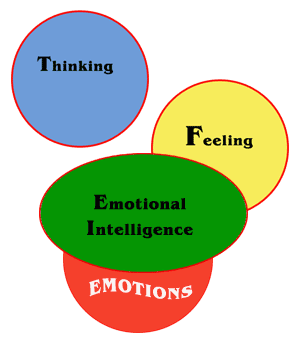
Is Emotional Intelligence related to Feeling, yet something distinctly
different and unrelated to Jung-Myers Thinking?
 Continue Reading How EI & EQ relate to MBTI Personality Type
® MBTI, Myers-Briggs, Meyers Briggs, and Myers-Briggs Type Indicator are registered trademarks or trademarks of the Myers-Briggs Type Indicator Trust in the United States and other countries (aka meyers briggs or myers briggs).
*The Bulletin of Psychological Type is published by the Association for Psychological Type, a membership organization for persons interested in advancing the practical application of psychological type. Information about publication and membership can be obtained here.

Other Popular or New Articles on Personality Type
Mobile Friendly Version of our Free Personality Type Test
The Civil War between Feeling and Thinking

Trump - The Mouth that Roared Once Too Often?

 Most Popular Articles
About the MBTI - An Introduction to Myers-Briggs Personality Type.
Myers Briggs Test - What is your Personality Type?
Profiles of the 16 Myers-Briggs Personality Types.
Verifying your MBTI or Myers-Briggs Personality Type.
Myers-Briggs Mental Processes - What's Your "Super-Power"?
Author Lenore Thomson on Questions, Quandries, and Queries about Personality Type
Haas and Hunziker on
Building Blocks of Personality
MBTI BOOKSHELF - our recommended books and booklets on Myers-Briggs personality type
|


The MBTI Personality Type of Donald Trump - looking behind the media mask of The Donald.
© Published by Ross Reinhold & Reinhold Development 1997 - 2023
Privacy Policy About Us